The Almudena Cathedral in Madrid, the capital’s signature church
• Fascinating Spain
• Community of Madrid
Spain is full of wonderfulcathedrals. Some of them, like the ones in León, Burgos, Santiago de Compostela or Segovia, are incredibly popular. Meanwhile, it is easy to forget about other cathedrals that stand out a little less, either because they are more modern or because they lie in the verycity centre of Madrid. This is the case of theAlmudena Cathedral. It might be less popular than the others, but this temple leaves all visitors speechless.
Brief history of the Almudena Cathedral
Brief history of the Almudena Cathedral
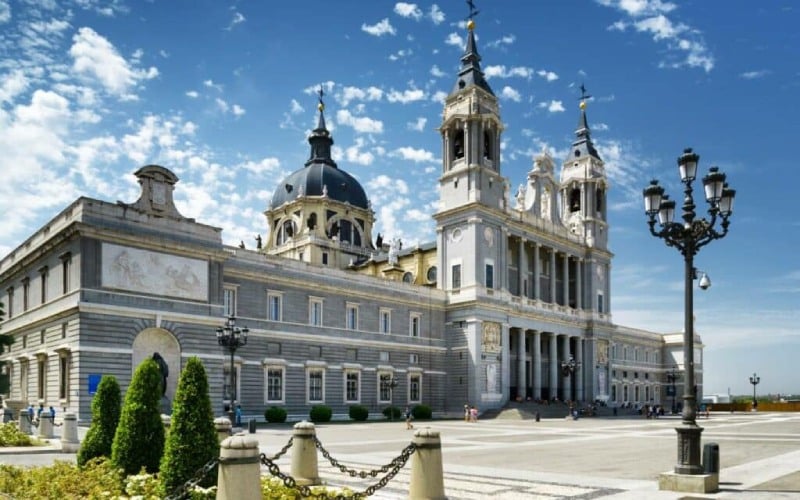 The Almudena Cathedral. | Shutterstock
The Almudena Cathedral. | Shutterstock
Visiting the Almudena Cathedral is an experience anyone travelling to Madrid should have. Not only due of its stunning architecture, but also because its history is just fascinating. It all started around the year 1868, when the congregation called Real Esclavitud de Santa María la Real de la Almudena asked permission to the archbishop of Toledo for buildinga church dedicated to the Virgin of Almudena.This way, the Spanish Crown handed them over the area of land in front of the Royal Palace of Madrid. One can actually visit both jewels of Madrid in a few steps, since they are only metres apart.
The architect behind this work was Francisco de Cubas y Montes. In 1885, Pope Leo XIII made Madrid a diocese and thechurchbecame a cathedral. As a consequence, Francisco de Cubas y Montes altered his original plan. Now the temple would havea larger size, a French flamboyant neo-Gothic style, a Latin cross floor plan, and side chapels.In fact, the Almudena Cathedral, or the Catedral de Santa María la Real de la Almudena, which is its full name, is divided into three naves with a semicircular apse and an ambulatory.
Sunset at the Almudena Cathedral. | Shutterstock
The vault of the Almudena Cathedral was one of the first parts they built, although Francisco de Cubas y Montes did not live to see it. It was Miguel Olabarría, Enrique Repullés and Vargas y Juan Moya who began to work on the cathedral’s construction.The most important modifications were made throughout the 20thcentury.They lowered its height to match with theRoyal Palace, built a new cloister for the archbishopric, made the paving with green and cream-coloured marble, and built an altarpiece for the Virgin of Almudena.
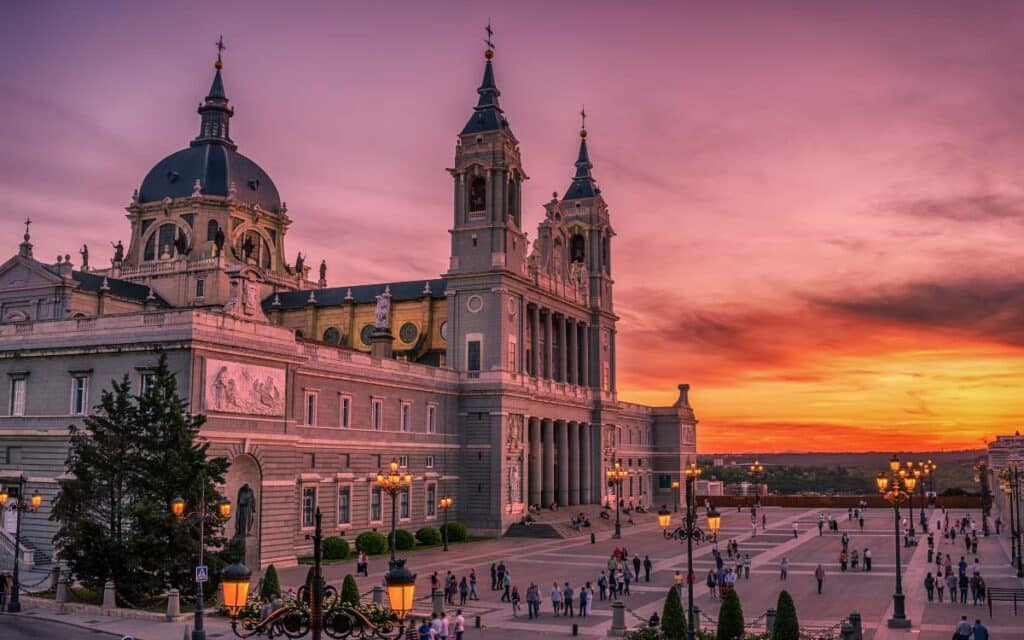 Sunset at the Almudena Cathedral. | Shutterstock
Finally, after 110 years of construction,on the 15 June 1993,Pope John Paul IItravelled to Madrid to consecrate the Almudena Cathedral.Even after that, they continued with the construction works and further refined details for a few years.
What to see at the Almudena Cathedral
What to see at the Almudena Cathedral
Exterior of the Almudena Cathedral
Exterior of the Almudena Cathedral
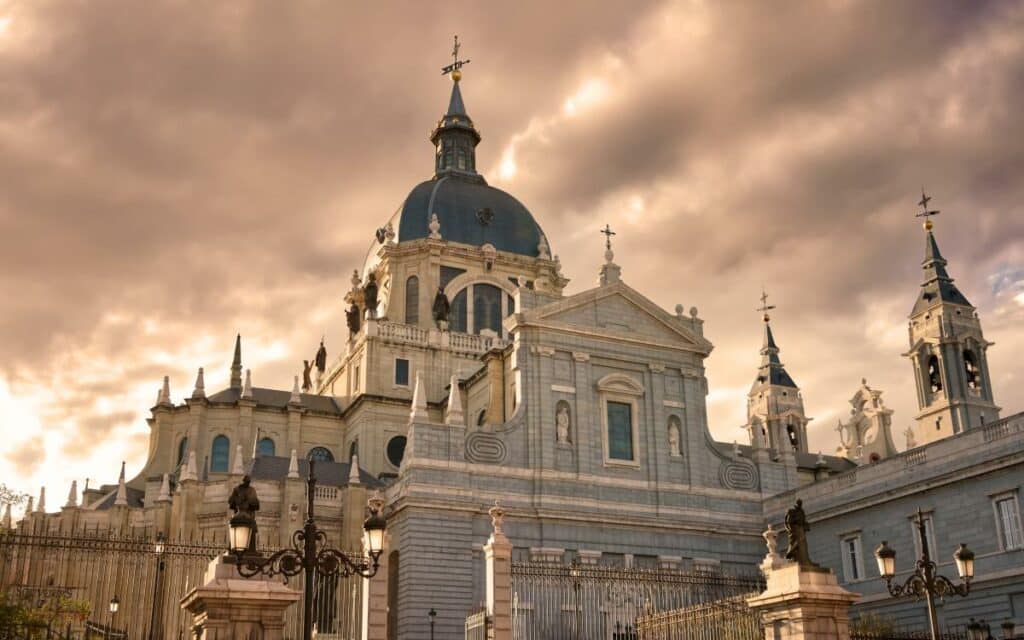 The exterior of the church. | Shutterstock
The exterior of the church. | Shutterstock
The Catedral de Santa María la Real de la Almudena, better known as the Almudena Cathedral, is one of those must-sees in Madrid one simply cannot miss. The first thing to strike the visitor will beits exterior look, with a double dom.If we look at its interior, the style isGothic, but the outside has baroque nuances.
Regarding its mainfaçade, it has a great portico with two rows of columns. Their lower part shows a Tuscan influence, whereas the upper section imitates the Ionic order. There is alsoa baroque niche hosting the Virgin of Almudena,which was placed there after the consecration of the temple. It is also worth mentioning the fourstatuesby sculptor Ramón Chaparro: San Isidro Labrador, Santa María de la Cabeza, Santa Teresa de Jesús and San Fernando.
The tower to the right of the main façade is known as Marianaor “de los Gallegos”, because its bells were donated by Galician people. All their names are related to the Virgin Mary: Santa María la Real de la Almudena, Santa María de la Paloma, Santa María de Atocha and Santa María de la Flor de Lis. Moreover, the tower to the left has a carillon and its bells are called Benedicta, Ancilla Domini, Magnificat and Gratia Plena.
The façade facing the street of Bailén is the one people use everyday to enter the Almudena Cathedral.The monumental bronze gateswere made by the sculptor Sanguino. They portray how Alfonso VI of León and Castile found the Virgin of Almudena the day Pope John Paul II consecrated the cathedral, and the procession of the virgin through the streets of Madid. Asquarededicated to the pope lies in front of this façade, hosting a statue of more than three metres that pictures John Paul II, designed by Juan de Ávalos. There are also four fountains and streetlights offernandinostyle, from the reign of Fernando VII of Spain.
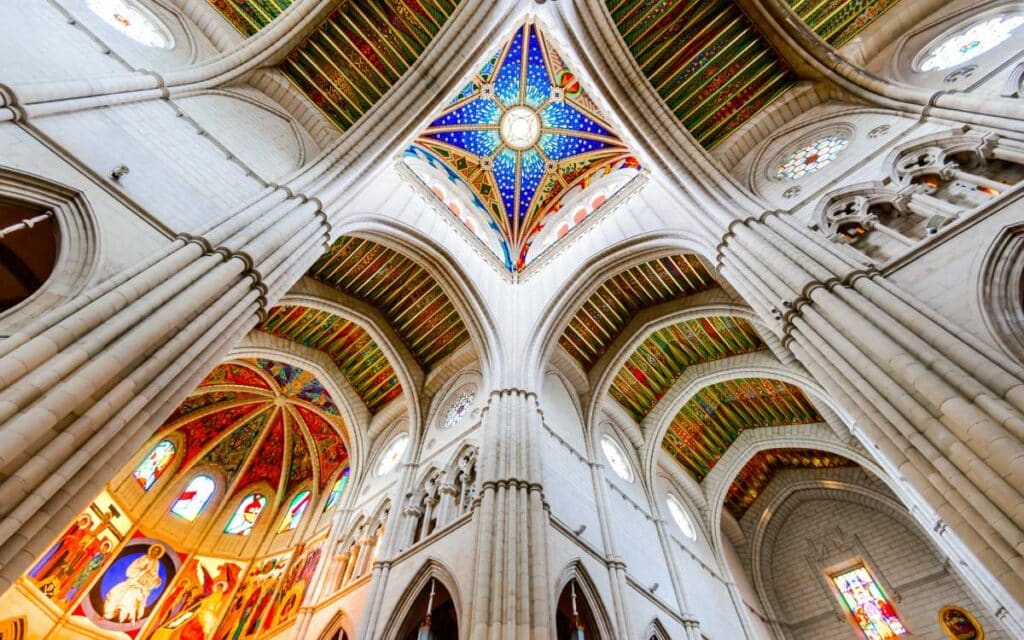 Details of the Almudena Cathedral. | Shutterstock
Interior of the Almudena Cathedral
Interior of the Almudena Cathedral
Details of the Almudena Cathedral. | Shutterstock
The Almudena Cathedral hasa Latin cross floor plan with a central nave and two lateral aisles.The main altarpiece displays a beautiful green marble. Behind it lies a sculpture depicting the Crucifixion of Jesus. This baroque work of art was designed by Juan de Mesa.
Of course,the Virgin of Almudena has her own altaron the right nave. It is a polychrome wooden structure of Gothic style placed in the central niche of an altarpiece, and it was made by Juan de Borgoña.
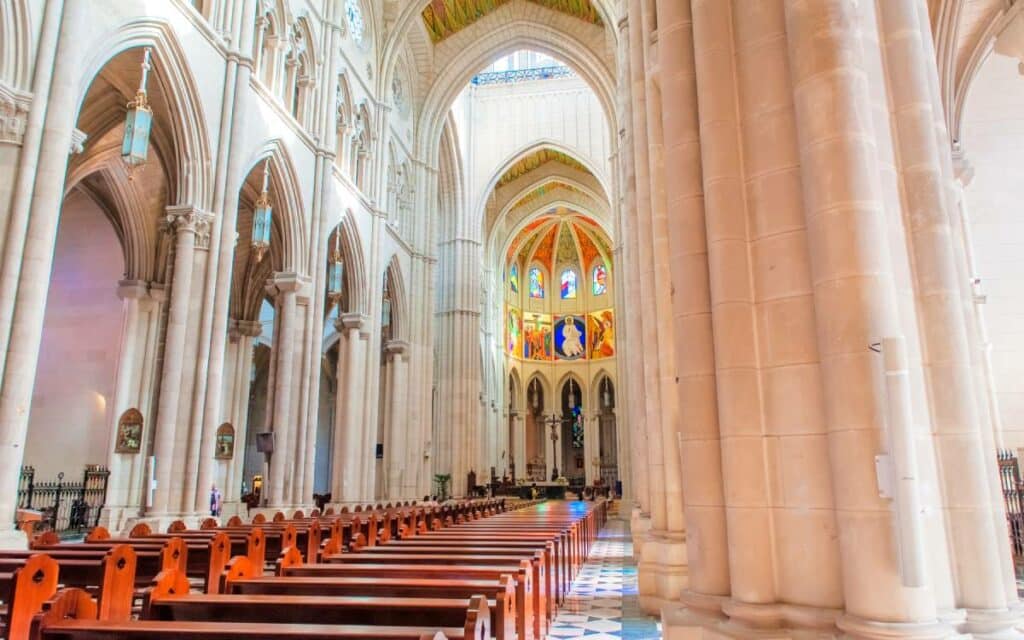 Interior of the temple. | Shutterstock
Interior of the temple. | Shutterstock
When it comes tothe chapels of the central nave, the most outstanding ones are thechapelof the Santísimo and the central chapel of the ambulatory, dedicated to San Isidro Labrador and Santa María de la Cabeza. The chapels of the other naves are dedicated to contemporary saints.
The stained glass and the muralsby Kiko Argüello stand out inside the Almudena Cathedral. They depict the Baptism, the Transfiguration, the Crucifixion, Christ Pantocrator, the Resurrection, the Ascension of Jesus, and the descent of the Holy Spirit on Pentecost. The visitor will also be able to access the sacred art museum, which includes an entrance to the cathedral’sdome.
Crypt of the Almudena Cathedral. | Shutterstock
To end with,the crypt of the cathedralfollows a Neo-Romanesque style and it keeps a 16th-century depiction of the Virgin of Almudena. The most outstanding aspect of the crypt is perhaps the fact that it holds more than 400 columns with capitals. They mostly portray biblical figures and elements of nature. Lastly, it is worth mentioning that it holds five naves and 18 chapels too.
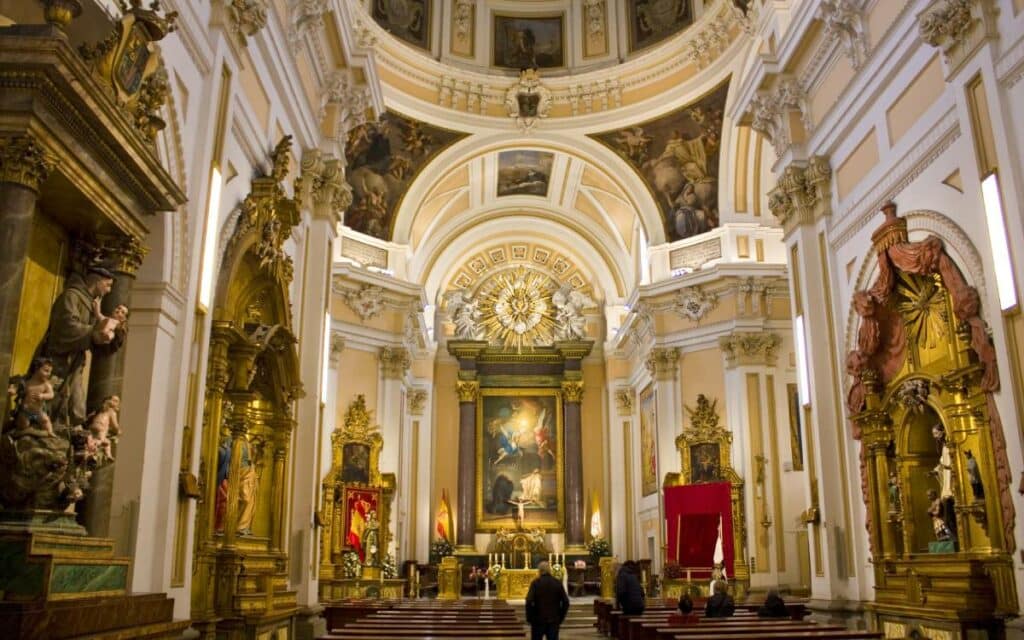 Crypt of the Almudena Cathedral. | Shutterstock
All in all, paying a visit to the Almudena Cathedral is fundamental for anyone wanting to explore Madrid and enjoya magnificent temple.
Источник: Fascinating Spain